
11+ Mock Exams: When to Start and How to Spot “Ghost Progress”
The hidden trap that makes kitchen-table scores crumble on exam day — and how to fix it
PrepTicks Team
July 2026
If your child is on the 11+ journey, there comes a point where standard worksheets and untimed practice papers no longer cut it. You need to know how they'll perform when the pressure is on.
Enter the 11+ mock exam.
Mocks are an invaluable tool — but many parents fall into a dangerous trap: starting them too early or using them too frequently. This often leads to a psychological phenomenon we call “Ghost Progress.”
Let's break down exactly when to introduce mocks, how to spot false progress, and how to build genuine exam-day confidence.
The Optimal Timeline for Mocks
Starting full, timed mock exams before your child has mastered the underlying curriculum is a recipe for anxiety and score plateaus. Think of it like trying to run a marathon before you've learned how to pace a 5K.
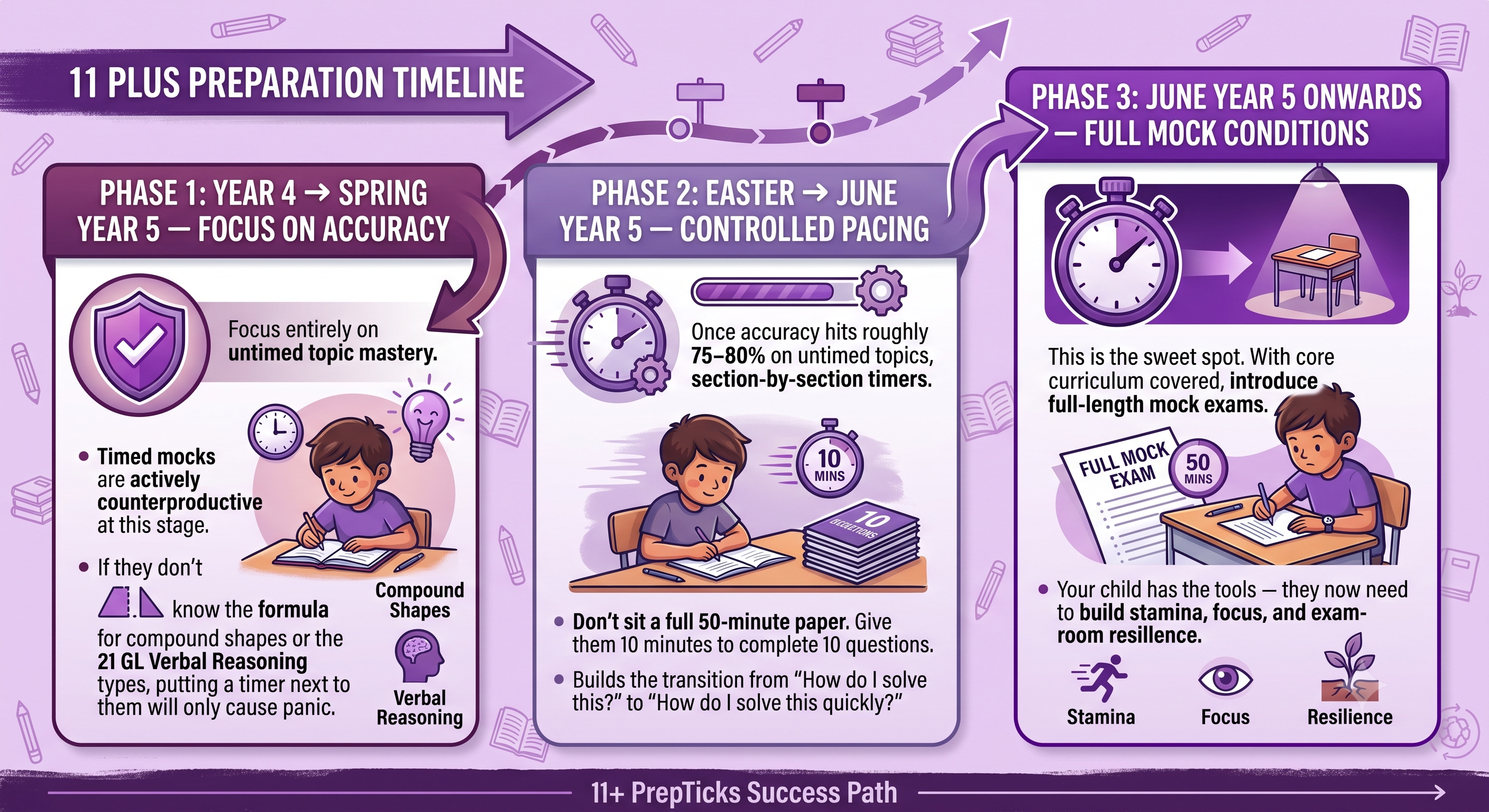
Phase 1: Year 4 → Spring Year 5 — Focus on Accuracy
Timed mocks are actively counterproductive at this stage. Focus entirely on untimed topic mastery. If they don't know the formula for compound shapes or the 21 GL Verbal Reasoning types, putting a timer next to them will only cause panic.
Phase 2: Easter → June Year 5 — Controlled Pacing
Once accuracy hits roughly 75–80% on untimed topics, introduce section-by-section timers. Don't sit a full 50-minute paper. Give them 10 minutes to complete 10 questions. This builds the transition from “How do I solve this?” to “How do I solve this quickly?”
Phase 3: June Year 5 onwards — Full Mock Conditions
This is the sweet spot. With core curriculum covered, introduce full-length mock exams. Your child has the tools — they now need to build stamina, focus, and exam-room resilience.
What is “Ghost Progress”?
Many parents are thrilled when their child consistently scores 85% or 90% on practice papers at the kitchen table — only to be devastated when a formal mock or the real 11+ results come back significantly lower.
Ghost Progress is a false inflation of scores caused by a comforting, overly familiar environment.
Here are the three warning signs:
1. The “Kitchen Table” Cushion
Familiar room, favourite pencil, you sitting nearby. A quiet hint about a word's meaning or an extra two minutes to finish — that 85% is no longer accurate. In a real exam hall, an invigilator won't grant extra time, and the silence feels deafening.
2. Predictability Layout Bias
If you only use one brand of practice papers, your child unconsciously memorises the font, spatial layout, and structural cadence. Switch providers — GL to Quest, for example — and their score plummets. They didn't lose ability; they lost predictability.
3. Topic Over-Familiarity
A mock right after a heavy week of fractions revision? Their maths score spikes. But a real 11+ paper requires cognitive shifting — algebra to charts to fractions word problems without warning.
How to Kill Ghost Progress
To ensure your child's progress is rock-solid and transportable to the real exam hall:
Vary the Testing Environment
Sit occasional papers in an unfamiliar room, the local library, or facing a wall. Introduce minor distractions — a ticking clock, someone turning pages nearby.
Enforce Zero-Assistance Boundaries
When the timer starts, your role changes from tutor to invigilator. No hints, no clarifications, no extra time. If three questions are blank when time's up, they stay blank. This teaches exam-day triage.
Mix the Question Delivery
Move beyond single-publisher books. Use platforms that randomise delivery across multiple topics and exam board styles (GL, Quest, CEM).
A mock exam is not a teaching tool — it's a diagnostic thermometer. Use it to find where the cracks are, not just to hunt for a high score to put on the fridge.
At PrepTicks, we design our practice modules to break predictability biases. By exposing students to fluid question styles, strict timers, and cross-topic shuffling, we eliminate Ghost Progress — and ensure the scores you see at home match the confidence they feel on exam day.
Build Real Exam Confidence
PrepTicks randomises questions, enforces strict timers, and tracks genuine progress — so there are no surprises on test day.